Hemicellulase for Baking: Industrial Process Guide
For flour mills, improver makers, bakeries and resellers: choosing, trialling and buying hemicellulase and xylanase for dough, with wholesale quotes per order.
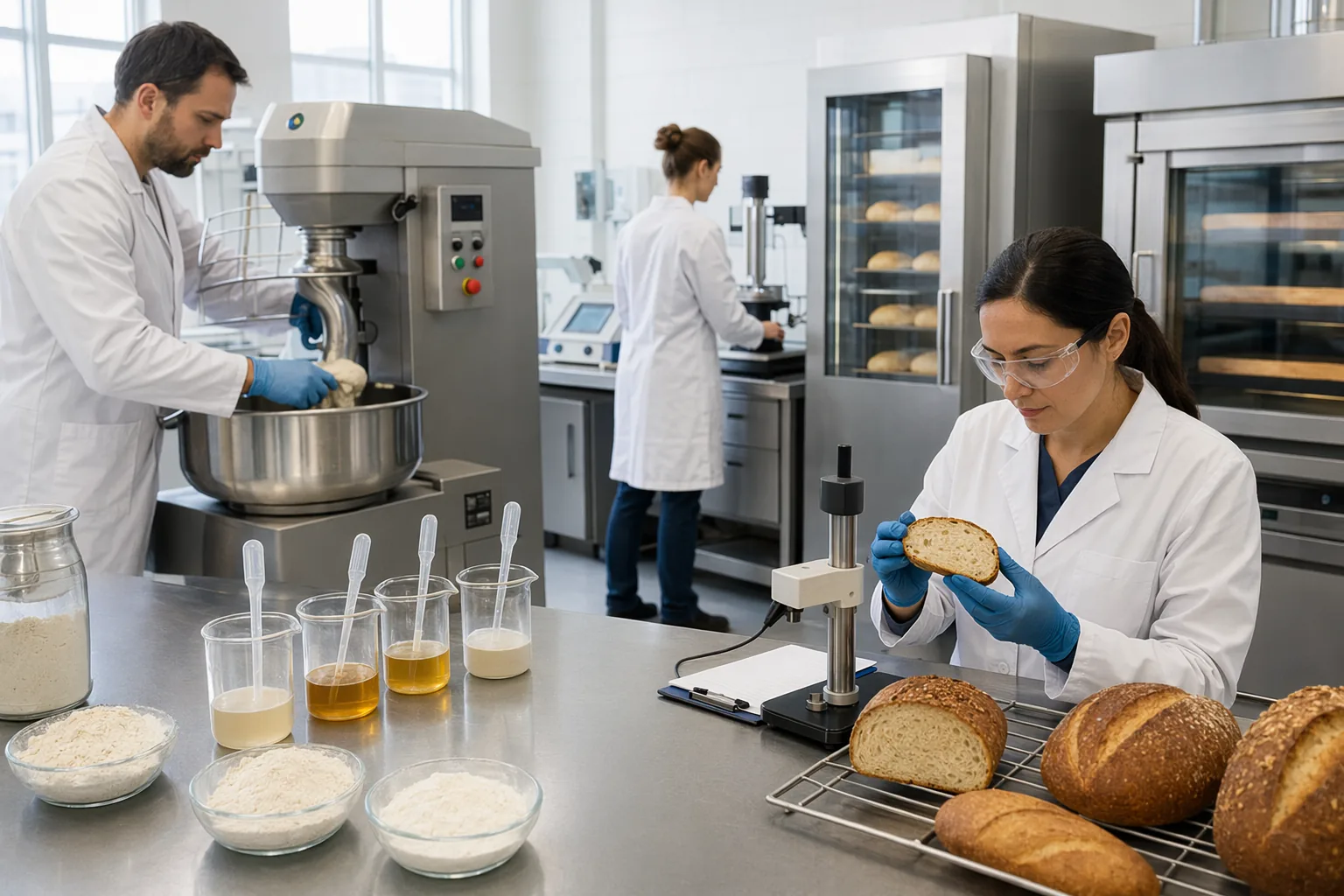
For flour mills, bread-improver and premix manufacturers, industrial bakeries and the distributors who supply them: how hemicellulase and xylanase are chosen, trialled and bought for dough handling, volume and crumb. Wholesale and bulk supply is quoted per order; send the product, quantity and destination to request a quote.
What Is Hemicellulase in a Baking Context?
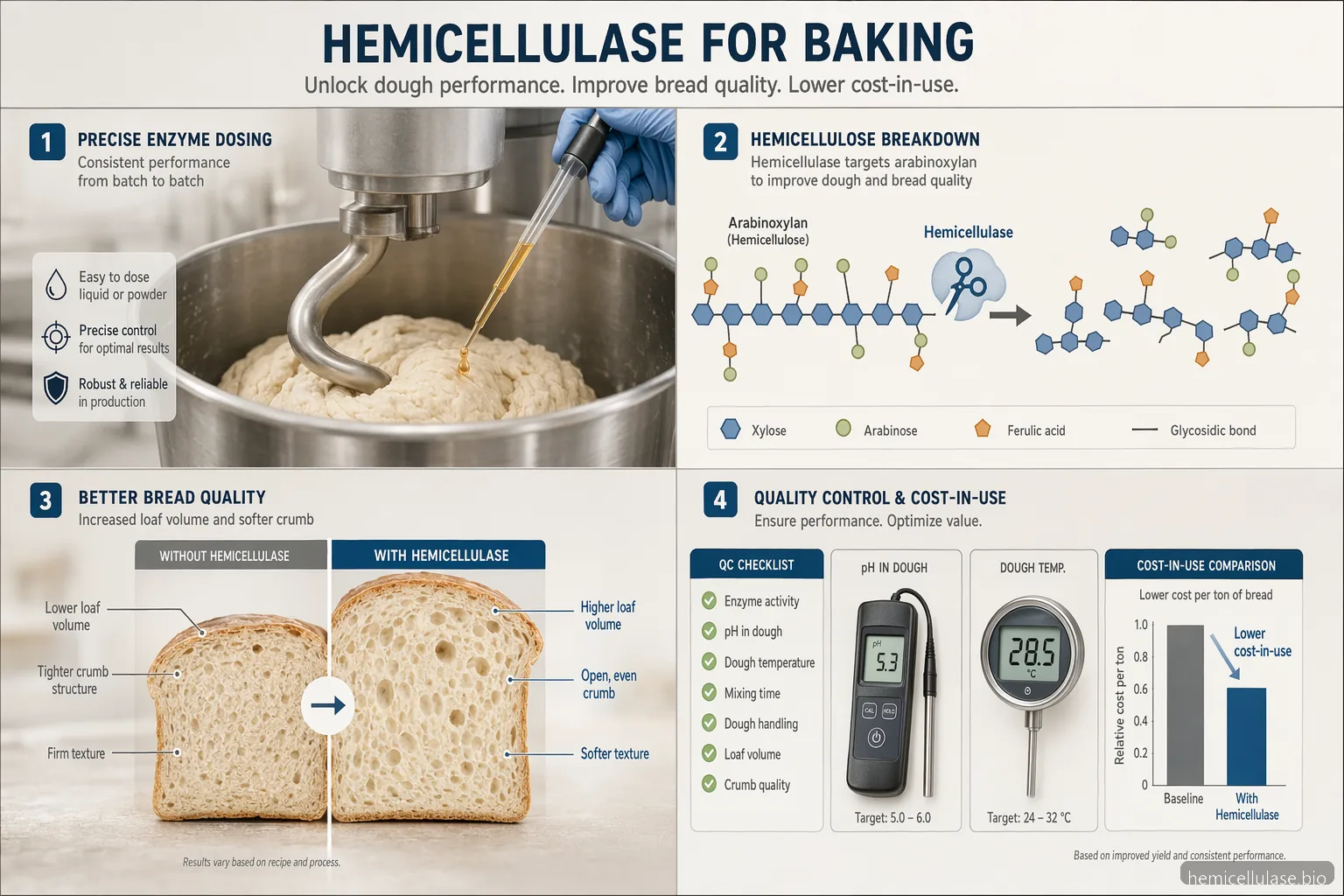
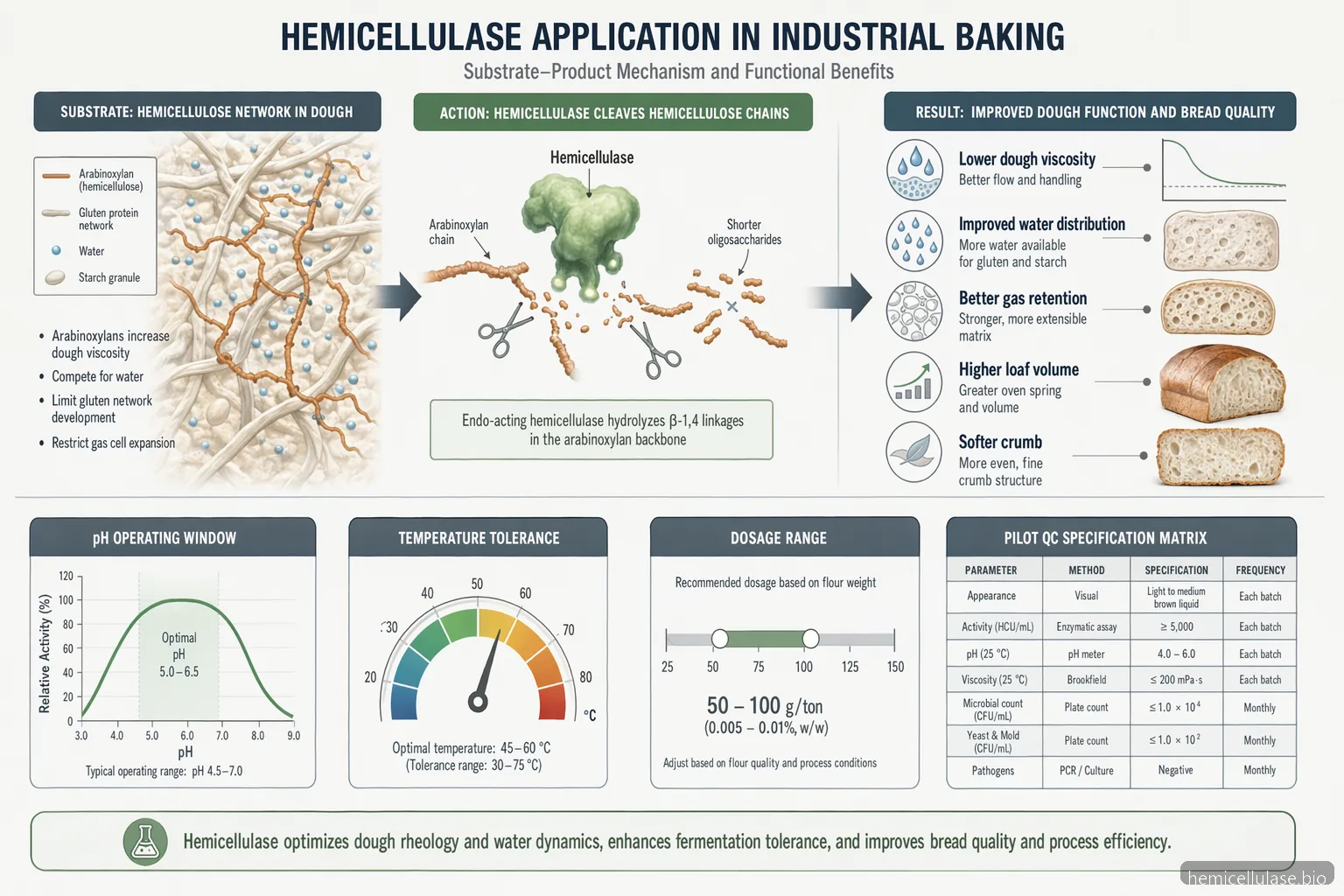
What is hemicellulase for industrial baking? It is not a single enzyme, but a functional group of enzymes that hydrolyze hemicellulose fractions in flour. In wheat-based systems, the most relevant activity is often xylanase, which modifies arabinoxylans. Depending on the formulation, a hemicellulase enzyme may also include beta-mannanase, arabinofuranosidase, beta-glucanase, or accessory activities. For B2B buyers, the important question is not only the enzyme name, but the substrate profile, declared activity, carrier system, and performance in the target flour. The main hemicellulase enzyme function in baking is controlled modification of non-starch polysaccharides, helping adjust water distribution, dough development, gas cell stability, and final crumb. Over-treatment can weaken dough or create sticky handling, so application trials should define a performance window before scale-up. The baking specification is on our hemicellulase for baking and dough conditioning page.
Primary target: flour hemicelluloses, especially arabinoxylans • Common activities: xylanase, mannanase, beta-glucanase, accessory enzymes • Main outputs: dough machinability, volume, crumb texture, process tolerance
Where Hemicellulase Fits in Bakery Processing
Hemicellulase application is most common in pan bread, buns, rolls, laminated doughs, frozen dough, steamed bread, and flour correction systems. The enzyme hemicellulase is usually added with dry minor ingredients, improver blends, or liquid enzyme dosing systems, depending on plant controls. In straight dough and sponge-and-dough processes, it acts during mixing, floor time, fermentation, proofing, and early baking before thermal inactivation. Typical operating conditions for wheat dough are pH 5.0-6.0 and dough temperatures around 24-30°C, with proofing often near 30-40°C. Actual activity depends on the supplier’s strain source, formulation, and activity method. During baking, the enzyme is progressively inactivated as crumb temperature rises, commonly above 70-90°C. Process teams should evaluate performance under real line conditions, including mixer energy, dough resting time, divider stress, proof humidity, and oven profile.
By product, the targets shift: pan bread and buns are bought for volume, crumb uniformity and softness over shelf life; high-speed lines care more about machinability, less dough tearing and stable gas retention; whole-grain and fibre-enriched products use the enzyme to manage the water competition between bran, gums and gluten; frozen dough needs process tolerance after thawing. Define one primary target per product, then optimise the dose around that measurable plant outcome.
Add via flour improver, dry blend, or controlled liquid dosing • Validate under actual mixing, proofing, and baking conditions • Confirm compatibility with oxidants, emulsifiers, ascorbic acid, and other enzymes
Straight Xylanase or a Ready Compound: What Flour Mills and Premix Makers Choose
Flour mills and improver makers buy the fibre-splitting enzyme in two shapes, and the choice decides who carries the formulation risk. The first is a straight neutral endo-xylanase, made by fermentation of a Trichoderma strain, sold for flour correction so a mill can turn a standard flour into a special-purpose flour. Its strongest fit is steamed-bun flour, and the same grade is also used by end users to improve the handling and finish of steamed buns and bread. The second is a ready compound built for one product, such as a cake enzyme that combines maltogenic amylase, lipase and xylanase on a starch carrier for chiffon and sponge cakes. That compound is sold on product outcomes the cake maker can see: a soft bite that lasts, better elasticity and cohesion, a higher rise, a fuller shape and a longer shelf life.
Straight xylanase vs product compound: Who buys it: flour mills and improver makers who set the dose themselves, vs bakeries and premix resellers who want one ingredient per product. What is inside: a neutral endo-xylanase with some cellulase activity that is not standardised, vs maltogenic amylase, lipase and xylanase on starch. Pack seen on labels: 1 kg, vs 1 kg bag or 10 kg drum. Shelf life on label: 18 months, vs 12 months. How the dose is set: by flour quality, confirmed in a baking or steaming test, vs per cake formula and flour, as one addition.
The straight grade is dosed in grams per hundred kilograms of flour, and its label says plainly that the real dose depends on the flour and is fixed only by a baking or steaming trial. It is a biologically active material, so it is stored cool, dry and out of sunlight, which matters for a reseller holding stock between orders.
What buyers get wrong: copying one mill's dose to another flour, when the label itself ties the dose to flour quality and a bake or steam test • ignoring the side activity: a straight xylanase can carry cellulase activity that is not standardised, so ask how much there is before a long-fermentation or frozen-dough trial • comparing the dose of a compound with the dose of a straight enzyme, when the compound already contains several enzymes and a carrier • holding stock past its date: the two labels here carry different shelf lives, 18 and 12 months, so rotate a mixed inventory by product
To request a quote, tell us whether you need a straight grade for flour correction or a compound for a named product, the quantity per order, your destination country and the flour or product type; we reply with a matched grade and a trial sample offer.
Dosage Strategy and Process Conditions
Because commercial hemicellulase products differ widely in activity and concentration, dosage should be specified by enzyme activity units whenever possible. As a screening range, bakery technologists often evaluate the equivalent of 10-100 ppm enzyme preparation on flour, or a supplier-recommended gram-per-ton flour range. Strong flours, high pentosan flours, whole wheat, rye-containing formulas, and fiber-enriched doughs may require different settings than standard white pan bread. Begin with a low, medium, and high dose, then compare against a no-enzyme control and current improver system. Monitor dough stickiness, extensibility, proof height, oven spring, loaf symmetry, and slicing behavior. Avoid assuming that more hemicellulase gives better results; excessive hydrolysis can reduce dough strength and create weak sidewalls or gummy texture. The best dose is the lowest level that delivers consistent process and finished-product benefits.
Initial screen: low, medium, high dose plus control • Use activity-based dosing rather than only product weight • Optimize for cost-in-use, not maximum enzyme addition • Recheck dose when flour crop, extraction rate, or formulation changes
Specification Points to Compare First
Do not compare products on the activity number alone: suppliers use different assay substrates, reaction times, pH values, temperatures and unit definitions, so a higher figure on one label can perform differently in dough. Start with the enzyme type, the declared activity method, the carrier, solubility, granulation and the recommended application range. For powdered improvers, dusting and blend uniformity matter; for liquid dosing, viscosity, preservative system and pump compatibility matter. Ask for a technical data sheet with pH and temperature profiles, a batch certificate of analysis and an SDS, plus guidance on interactions with amylase, lipase, protease and glucose oxidase.
Compare assay method, not only declared activity • Confirm powder or liquid format suits your dosing system • Review interaction with the other improver components
Quality Control and Pilot Validation
A robust hemicellulase application program should combine lab analytics, pilot baking, and production trials. Start with flour characterization, including protein, ash, moisture, damaged starch, falling number, and water absorption. Dough testing may include farinograph, extensograph, alveograph, or dynamic rheology, depending on internal standards. Bake trials should measure loaf volume, specific volume, crumb grain, crumb firmness over shelf life, crust color, sliceability, and sensory attributes relevant to the customer specification. Production validation should also track divider weight variation, dough temperature, proof time, pan flow, oven spring, waste, and downtime. Request a COA for each batch, the TDS for activity and application guidance, and the SDS for safe handling. Pilot validation is essential because cellulase and hemicellulase enzymes can interact with flour quality, emulsifiers, oxidizing systems, reducing agents, and fermentation variables.
QC checks: rheology, volume, crumb firmness, water absorption, sliceability • Document controls: COA, TDS, SDS, retained samples • Pilot before plant-wide conversion or supplier change
Troubleshooting on the Line
If the enzyme improves volume but the dough turns sticky, reduce the dose or re-balance water only after the dose is optimised. If there is no measurable response, check that the flour has enough accessible substrate, that the enzyme went in at the right point and that proof time allows it to act. If the crumb is too open or sidewalls collapse, the dose may be too high or the formula may need stronger oxidation, gluten support or a mixing change. If results swing between flour deliveries, tie flour analytics (protein, falling number, ash, absorption, rheology) to the dose decision. Premix plants should validate blend uniformity, because low-dose ingredients can separate.
Sticky dough: lower the dose or re-optimise water • No response: confirm substrate, addition point and proof time • Variable results: link flour testing to the dose
Supplier Qualification and Cost-in-Use
For procurement teams, the lowest price per kilogram may not be the lowest cost-in-use. Compare hemicellulase suppliers by declared enzyme activity, recommended dosage, formulation stability, batch-to-batch consistency, technical documentation, application support, and lead-time reliability. Ask whether the product is a single activity or a xylanase mannanase complex, and confirm that the activity profile matches the bakery challenge. Supplier qualification should include COA review, TDS comparison, SDS review, allergen and regulatory statements as applicable to the destination market, sample traceability, storage conditions, and shelf-life data. Run side-by-side trials using the same flour, water absorption, mixing energy, proof conditions, and oven profile. Calculate cost-in-use per metric ton of flour and per thousand finished units, including any reduction in waste, rework, or improver complexity that is demonstrated during validated trials.
Compare activity, performance, stability, and support • Calculate cost per ton of flour and per finished unit • Qualify suppliers with documentation and plant trials • Do not substitute products without revalidating the process
Comparing Offers: a Cost-in-Use Matrix
The winning product is rarely the cheapest drum. Put every candidate in one matrix: delivered price, recommended dose, measured performance in your trial, handling format, documentation quality, supplier responsiveness and technical support. A more concentrated enzyme can still cost more if it needs very tight dosing control; a lower-strength product can be cheaper in use if it disperses better in your premix and gives repeatable results. Premix makers should weight blend stability and carrier compatibility; bakeries dosing directly should weight powder flow or pumpability. Close the decision on batch consistency, supply continuity and total landed cost.
Calculate cost per tonne of flour treated • Include waste, yield and shelf-life targets • Rank suppliers on performance and reliability
Technical Buying Checklist
Buyer Questions
In bread, the main hemicellulase enzyme function is controlled modification of flour hemicelluloses, especially arabinoxylans. This can improve water distribution, dough extensibility, gas retention, loaf volume, and crumb softness when properly dosed. The effect depends on flour quality, formula, fermentation time, and enzyme activity profile. Overdosing can weaken dough or increase stickiness, so bakery trials are required.
Hemicellulase in bread primarily targets hemicellulose fractions such as arabinoxylans, while cellulase targets cellulose. In bakery systems, cellulase and hemicellulase enzymes may both affect fiber-rich doughs, but they are not interchangeable. Hemicellulase, especially xylanase, is more commonly used for wheat dough optimization. Any cellulase hemicellulase blend should be validated carefully for dough strength, stickiness, and crumb quality.
A practical screening approach is to test a low, medium, and high dose around the supplier’s recommendation. Many commercial evaluations begin near 10-100 ppm enzyme preparation on flour, but activity concentration varies widely. The final setting should be based on activity units, flour quality, product type, processing time, and cost-in-use. Always compare against a no-enzyme control and the current improver system.
Buyers should request a certificate of analysis for batch-specific activity, a technical data sheet for application guidance, and a safety data sheet for handling and storage. Additional useful documents include activity method, shelf-life data, storage conditions, regulatory statements for the intended market, allergen information where relevant, and traceability details. These records support supplier qualification and plant quality management.
A xylanase mannanase complex may be useful in bakery systems that contain wheat flour, whole grains, rye, fibers, gums, or other materials with mixed hemicellulose substrates. However, the activity ratio matters. Excessive side activities can change dough viscosity, stickiness, or crumb texture. Ask the supplier for substrate specificity, recommended dose, and baking trial data, then validate under your own formula and line conditions.
Where Hemicellulase Is Used Beyond the Bakery
Baking is one use among several. Three buyer guides on this site cover the other processes where the same fibre-splitting enzymes earn their place, each written around the plant's own cost problem:
• Wheat-based poultry feed and straw silage: /learn/xylanase-feed-and-silage/
• Pulp, board and straw fibre mills: /learn/xylanase-pulp-straw-wood-fibre/
• Juice, fruit wine and plant extraction: /learn/hemicellulase-juice-wine-plant-extraction/
Hemicellulase (Xylanase + Mannanase Complex) for Research & Industry
Need Hemicellulase (Xylanase + Mannanase Complex) for your lab or production process?
ISO 9001 certified · Food-grade & research-grade · Ships to 80+ countries
Frequently Asked Questions
What is the main hemicellulase enzyme function in bread?
In bread, the main hemicellulase enzyme function is controlled modification of flour hemicelluloses, especially arabinoxylans. This can improve water distribution, dough extensibility, gas retention, loaf volume, and crumb softness when properly dosed. The effect depends on flour quality, formula, fermentation time, and enzyme activity profile. Overdosing can weaken dough or increase stickiness, so bakery trials are required.
How is hemicellulase in bread different from cellulase?
Hemicellulase in bread primarily targets hemicellulose fractions such as arabinoxylans, while cellulase targets cellulose. In bakery systems, cellulase and hemicellulase enzymes may both affect fiber-rich doughs, but they are not interchangeable. Hemicellulase, especially xylanase, is more commonly used for wheat dough optimization. Any cellulase hemicellulase blend should be validated carefully for dough strength, stickiness, and crumb quality.
What dosage should a bakery start with?
A practical screening approach is to test a low, medium, and high dose around the supplier’s recommendation. Many commercial evaluations begin near 10-100 ppm enzyme preparation on flour, but activity concentration varies widely. The final setting should be based on activity units, flour quality, product type, processing time, and cost-in-use. Always compare against a no-enzyme control and the current improver system.
What documents should buyers request from a hemicellulase supplier?
Buyers should request a certificate of analysis for batch-specific activity, a technical data sheet for application guidance, and a safety data sheet for handling and storage. Additional useful documents include activity method, shelf-life data, storage conditions, regulatory statements for the intended market, allergen information where relevant, and traceability details. These records support supplier qualification and plant quality management.
Can a xylanase mannanase complex be used in baking?
A xylanase mannanase complex may be useful in bakery systems that contain wheat flour, whole grains, rye, fibers, gums, or other materials with mixed hemicellulose substrates. However, the activity ratio matters. Excessive side activities can change dough viscosity, stickiness, or crumb texture. Ask the supplier for substrate specificity, recommended dose, and baking trial data, then validate under your own formula and line conditions.
Why did the enzyme make our dough sticky?
Usually the dose is too high, the flour is very responsive, water was not re-balanced, or the product carries extra activities that affect dough structure. Reduce the dose, repeat the trial with fixed water, then adjust absorption only after the best dose is known; check proof time and temperature too.
What are the signs of overdosing in dough?
Excess stickiness, weak structure, poor machinability, low proof tolerance, irregular crumb or collapsed loaves. Reduce the dose, shorten exposure time or re-balance with other improver components.
Request a Quote for Wholesale or Bulk Supply
Flour mills, improver makers, bakeries and distributors: send the product (straight grade or compound), the quantity per order, the destination country and your flour or product type. We reply with a matched grade, a trial sample offer and a quote per order. See our application page for Hemicellulase Enzyme for Animal Feed Digestibility at /applications/hemicellulase-animal-feed-digestibility/ for specs, MOQ, and a free 50 g sample.
Contact Us to Contributehello@mail.hemicellulase.bio