Hemicellulase Supplier for Baking: How to Use Hemicellulase in Baking Formulations
Wholesale hemicellulase for bakeries, improver makers and distributors: what to ask a supplier, how to trial it, how to compare offers. Request a quote per order.
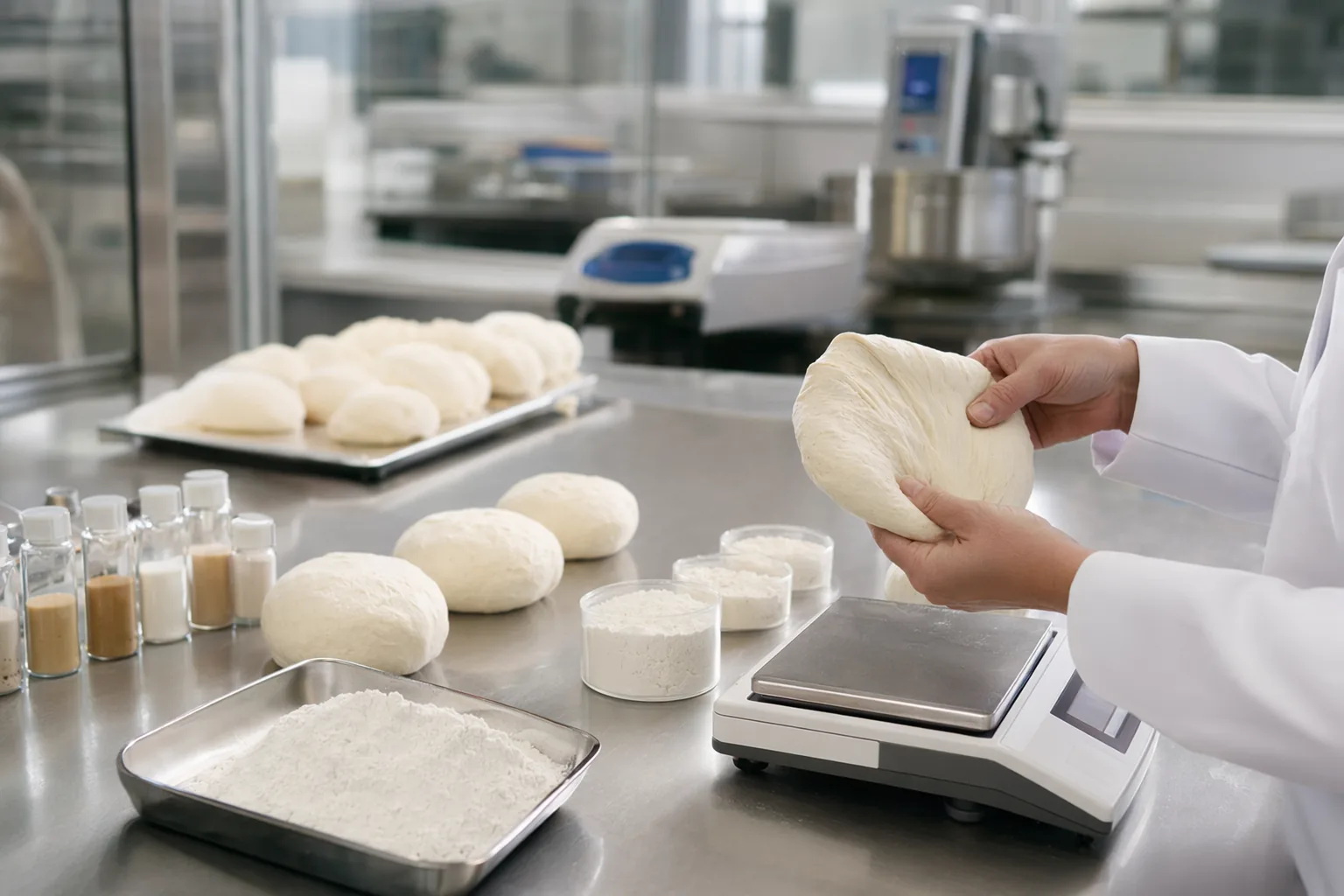
For bakeries, premix and flour-improver manufacturers, and the distributors and resellers who supply them: what to ask a hemicellulase supplier, how to prove the enzyme in your own flour, and how to compare offers on cost-in-use. Wholesale and bulk supply is quoted per order; to request a quote, send the product, the quantity and the destination country.
What Hemicellulase Does in Baking
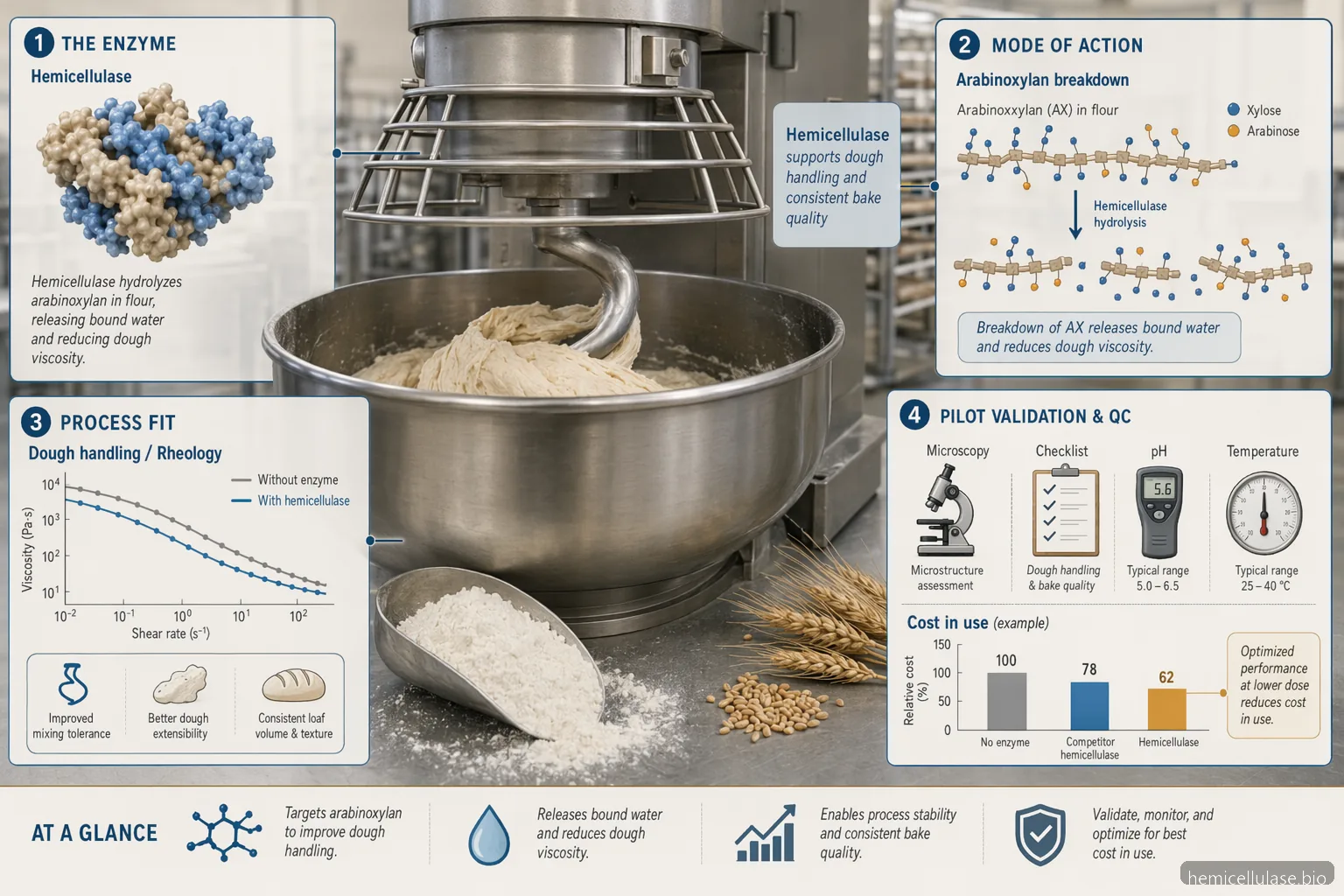
Hemicellulase is a group of enzymes that hydrolyze hemicellulose components in plant cell walls, especially arabinoxylans found in wheat and rye flour. In baking, the most common activity is xylanase, often supported by related side activities depending on the product design. A well-selected industrial hemicellulase enzyme baking formulation can reduce excessive dough viscosity, improve water distribution, support gas retention, and help produce a more uniform crumb. The goal is controlled modification, not complete breakdown. Overdosing may cause sticky dough, weak handling, or poor shape retention, so the enzyme must be matched to flour quality and process time. Buyers searching for a hemicellulase supplier for baking should focus on activity profile, application data, and reproducible performance across flour lots rather than only price per kilogram.
Primary target: water-extractable and water-unextractable arabinoxylans • Common benefit areas: dough handling, volume, crumb softness, and uniformity • Key risk: overdosing can create sticky or slack dough
Recommended Formulation and Process Conditions
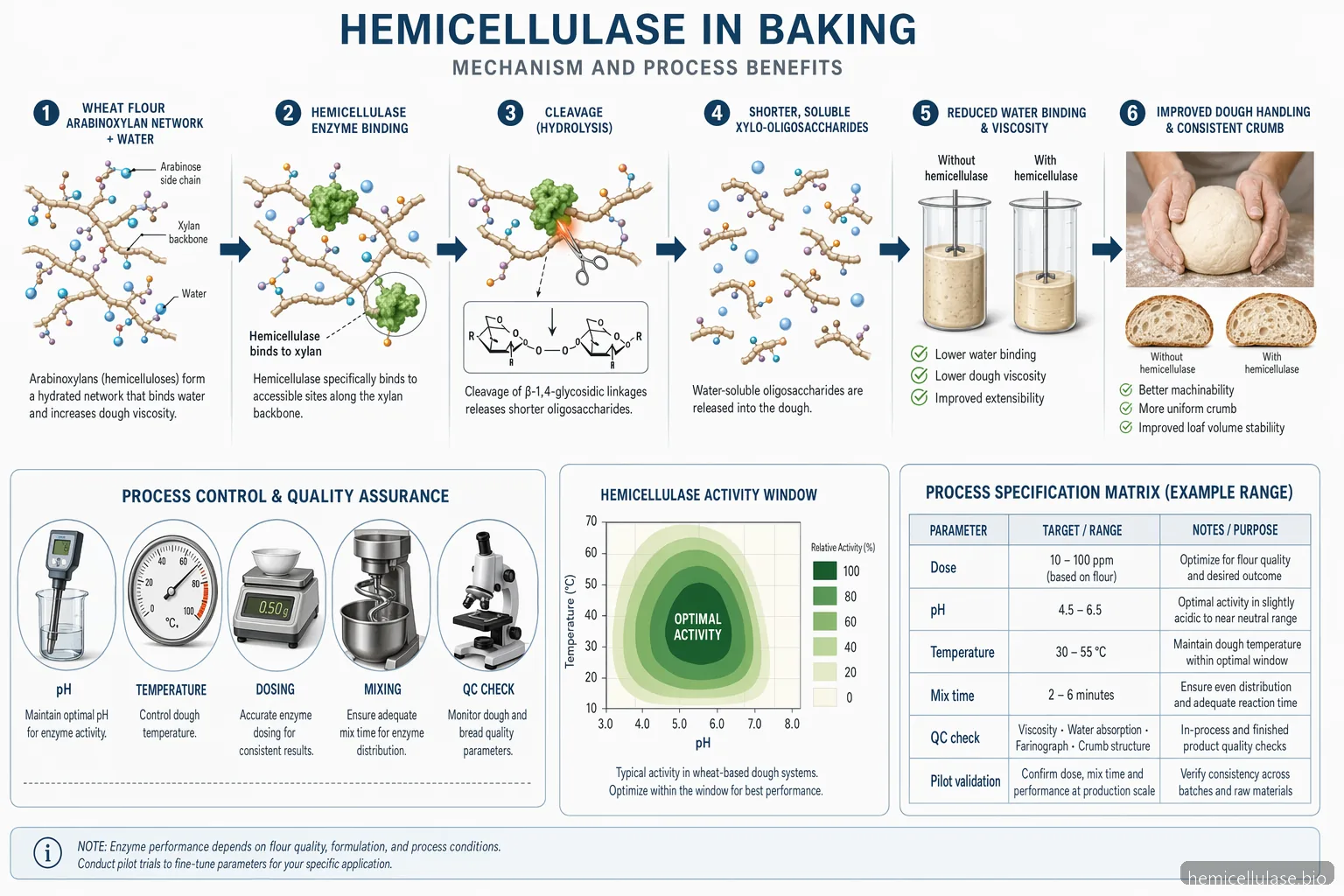
For industrial hemicellulase baking applications, starting dosage is commonly evaluated in the range of 10 to 100 ppm on flour weight, depending on enzyme activity, flour type, process length, and desired effect. Some concentrated products may require lower inclusion rates, while diluted bakery premixes may be dosed higher. Most baking-relevant hemicellulase products perform in mildly acidic to near-neutral dough systems, typically around pH 4.5 to 6.5. Dough temperatures of 24 to 32 degrees Celsius are common during mixing and fermentation, while enzyme activity declines during baking as heat denatures the protein. Validation should use the customer’s actual flour, water absorption, mixing energy, fermentation schedule, and bake profile. For frozen dough, par-baked goods, or long fermentation systems, trial dosage should be conservative because enzyme contact time is extended.
Initial trial band: 10-100 ppm on flour weight • Typical dough pH: 4.5-6.5 • Typical dough temperature: 24-32 degrees Celsius • Validate separately for fresh, frozen, and long-fermentation processes
Choosing a Hemicellulase Enzyme Supplier for Baking
A hemicellulase enzyme supplier for baking should support both procurement and technical teams. Request a current Certificate of Analysis, Technical Data Sheet, Safety Data Sheet, allergen or handling statement where relevant, recommended storage conditions, and the analytical method used to define activity. The supplier should clarify whether the product is a single dominant xylanase, a broader hemicellulase blend, or a xylanase mannanase complex supplier for baking applications where multiple side activities are desired. For flour improver producers, compatibility with ascorbic acid, emulsifiers, fungal alpha-amylase, lipase, glucose oxidase, and anti-caking carriers may also be important. Supplier qualification should include batch-to-batch consistency, lead time, packaging options, change notification practices, and technical responsiveness during pilot trials. Avoid relying on generic activity numbers unless the test method and unit definition are disclosed.
Request COA, TDS, SDS, activity method, and storage guidance • Confirm whether the enzyme is single-activity or blended • Assess batch consistency, packaging, lead time, and change control • Check compatibility with the full flour improver system
Pilot Validation and QC Checks
Pilot validation should compare a control formula against at least three enzyme dosage levels, using the same flour lot, mixer, proofing conditions, and bake profile. Measurements should include farinograph or mixograph behavior where available, water absorption, dough stickiness, extensibility, proof height, loaf volume, crumb grain, sliceability, and sensory handling observations. For routine QC, incoming hemicellulase should be checked against the COA for activity, appearance, lot number, manufacturing or retest date, and storage condition. In-plant checks may also include bake tests on standard flour and retained samples from prior lots. Because flour arabinoxylan content varies by wheat origin, crop year, and milling stream, the best specification is not only an enzyme activity value but also a performance window in the buyer’s formulation. The baking specification is on our hemicellulase for baking and dough conditioning page. Documenting these results helps purchasing compare suppliers on reliable cost-in-use.
Run control plus low, medium, and high dosage trials • Measure dough rheology, loaf volume, crumb structure, and handling • Verify incoming lots against COA and retained standards • Use performance data to define the approved dosage window
Before a Bulk Order: Run a Dose Ladder
Do not copy a dose from another bakery: flour extraction rate, pentosan content, ascorbic acid, emulsifiers, water absorption and process time all change the response, and concentrated products need far lower inclusion than diluted ones. Run a ladder (control, low, medium and high dose) holding water and mixing constant, then repeat with optimised absorption if the dough opens up. Convert the supplier's recommendation into cost per tonne of flour before you sign a bulk contract, and agree the escalation steps if a later lot performs differently.
Start with a controlled dose ladder before changing water • Convert recommendations into cost per tonne of flour • Track dough handling and finished-bread quality together
Cost-in-Use for Industrial Hemicellulase Baking
For B2B buyers, the lowest price per kilogram is not always the lowest cost-in-use. Industrial hemicellulase baking cost should be calculated from effective dosage, enzyme concentration, dilution carrier, inclusion accuracy, storage stability, waste reduction, and finished product performance. A more active product may reduce dosage, but it must still disperse uniformly in flour or premix systems. A diluted product may be easier to dose but can increase freight and storage cost. Evaluate whether the enzyme reduces formulation complexity, improves process tolerance, or helps stabilize output across variable flour quality. The same supplier may also offer adjacent products for customers seeking a hemicellulase supplier for animal feed, hemicellulase supplier for biofuel, or hemicellulase supplier for pulp and paper, but baking applications require food-process performance data and bakery-specific technical support.
Compare cost per metric ton of flour treated • Include freight, storage, dosage accuracy, and waste impact • Confirm dispersion in flour, premix, or liquid dosing systems • Prioritize bakery-specific validation over generic enzyme claims
Qualifying a Supplier for Long-Term Supply
Price per kilogram is only one part of the decision. Calculate cost per tonne of flour at the validated dose, then add waste reduction, process tolerance, rework risk, lead time, minimum order, pack size and stock stability. Qualify the supplier on manufacturing consistency, document accuracy, responsiveness, export experience, sample-to-shipment consistency and willingness to support complaints with batch records. For long-term supply, ask for a change-control process covering formulation, carrier, activity method, production site and packaging, and keep an approved backup supplier. The goal is not the strongest enzyme on paper; it is the most predictable result at an acceptable total cost.
Compare cost per tonne of flour, not only enzyme price • Confirm lead time, MOQ, pack size and shelf life • Ask how formulation or process changes are communicated • Keep an approved backup supplier
Technical Buying Checklist
Buyer Questions
There is no universal best dosage because flour arabinoxylan content, enzyme activity, fermentation time, and formula design vary. A practical starting range is often 10-100 ppm on flour weight for concentrated industrial hemicellulase, followed by pilot trials. Test at least three levels against a control and measure dough handling, proof tolerance, loaf volume, crumb grain, and sliceability before setting a plant dosage.
Compare suppliers by activity method, baking performance data, COA consistency, TDS detail, SDS availability, storage stability, technical support, and pilot sample responsiveness. Ask whether the product is a dominant xylanase, a broader hemicellulase blend, or a xylanase mannanase complex supplier for baking applications. Final selection should be based on cost per ton of flour treated and verified bakery performance.
Yes, hemicellulase is often evaluated with fungal alpha-amylase, glucose oxidase, lipase, protease, or emulsifier systems in flour improvers. Compatibility depends on the formula and process. Because enzyme interactions can be additive or excessive, run structured trials rather than adding multiple enzymes at maximum dose. Monitor dough strength, stickiness, volume, crumb softness, and shelf-life indicators under your actual production conditions.
Request a current COA for the supplied lot, a TDS with activity definition and application guidance, an SDS for safe handling, storage and retest information, packaging details, and traceability documentation. For supplier approval, also ask about change notification, batch consistency, sample availability, and technical support for pilot validation. These documents help quality, regulatory, procurement, and production teams assess risk.
The enzyme class may overlap, but the product requirements are different. Baking needs performance in dough systems, controlled action, suitable handling documents, and food-process application support. A hemicellulase supplier for biofuel or a hemicellulase supplier for pulp and paper may optimize for higher temperatures, biomass hydrolysis, or fiber modification instead. Always qualify the exact product for baking use.
Hemicellulase (Xylanase + Mannanase Complex) for Research & Industry
Need Hemicellulase (Xylanase + Mannanase Complex) for your lab or production process?
ISO 9001 certified · Food-grade & research-grade · Ships to 80+ countries
Frequently Asked Questions
What is the best dosage for hemicellulase in bread?
There is no universal best dosage because flour arabinoxylan content, enzyme activity, fermentation time, and formula design vary. A practical starting range is often 10-100 ppm on flour weight for concentrated industrial hemicellulase, followed by pilot trials. Test at least three levels against a control and measure dough handling, proof tolerance, loaf volume, crumb grain, and sliceability before setting a plant dosage.
How do I compare hemicellulase suppliers for baking?
Compare suppliers by activity method, baking performance data, COA consistency, TDS detail, SDS availability, storage stability, technical support, and pilot sample responsiveness. Ask whether the product is a dominant xylanase, a broader hemicellulase blend, or a xylanase mannanase complex supplier for baking applications. Final selection should be based on cost per ton of flour treated and verified bakery performance.
Can hemicellulase be used with other bakery enzymes?
Yes, hemicellulase is often evaluated with fungal alpha-amylase, glucose oxidase, lipase, protease, or emulsifier systems in flour improvers. Compatibility depends on the formula and process. Because enzyme interactions can be additive or excessive, run structured trials rather than adding multiple enzymes at maximum dose. Monitor dough strength, stickiness, volume, crumb softness, and shelf-life indicators under your actual production conditions.
What documents should an industrial enzyme buyer request?
Request a current COA for the supplied lot, a TDS with activity definition and application guidance, an SDS for safe handling, storage and retest information, packaging details, and traceability documentation. For supplier approval, also ask about change notification, batch consistency, sample availability, and technical support for pilot validation. These documents help quality, regulatory, procurement, and production teams assess risk.
Is hemicellulase for baking the same as hemicellulase for biofuel or pulp and paper?
The enzyme class may overlap, but the product requirements are different. Baking needs performance in dough systems, controlled action, suitable handling documents, and food-process application support. A hemicellulase supplier for biofuel or a hemicellulase supplier for pulp and paper may optimize for higher temperatures, biomass hydrolysis, or fiber modification instead. Always qualify the exact product for baking use.
Which QC checks matter most for a baking hemicellulase?
Check each incoming lot against its COA for activity, appearance, lot number and date; keep retained samples; and run a standard bake test on reference flour so a weak or strong lot shows up before it reaches the line. Tie the approved dose to the trial result, not to the activity figure alone.
Request a Quote for Wholesale or Bulk Supply
Bakeries, improver makers, distributors and resellers: send the product, the quantity per order and per year, the destination country and your flour type. We reply with a recommended grade, a sample offer with COA and TDS, and a quote per order.
Contact Us to Contributehello@mail.hemicellulase.bio