Hemicellulase Enzyme Powder for Industrial Baking
Hemicellulase enzyme powder for bread improvers, premixes and industrial bakeries: selection, trials, documents, cost-in-use. Wholesale supply, quoted per order.
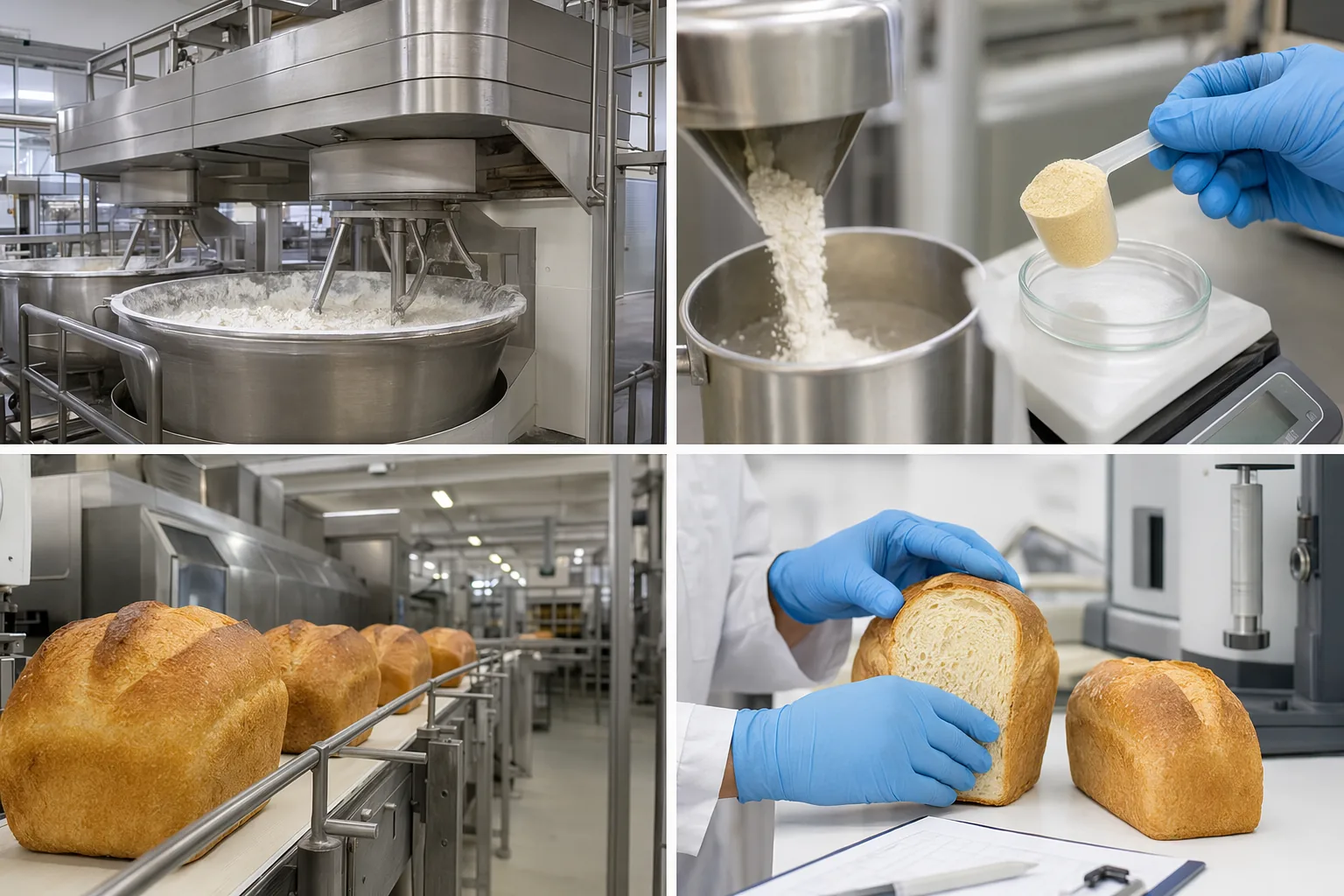
For bread-improver and premix manufacturers, industrial bakeries and the distributors who supply them: how to select, trial and scale a hemicellulase enzyme powder for dough handling, loaf volume and crumb. Wholesale and bulk supply is quoted per order; send the product, quantity and destination to request a quote.
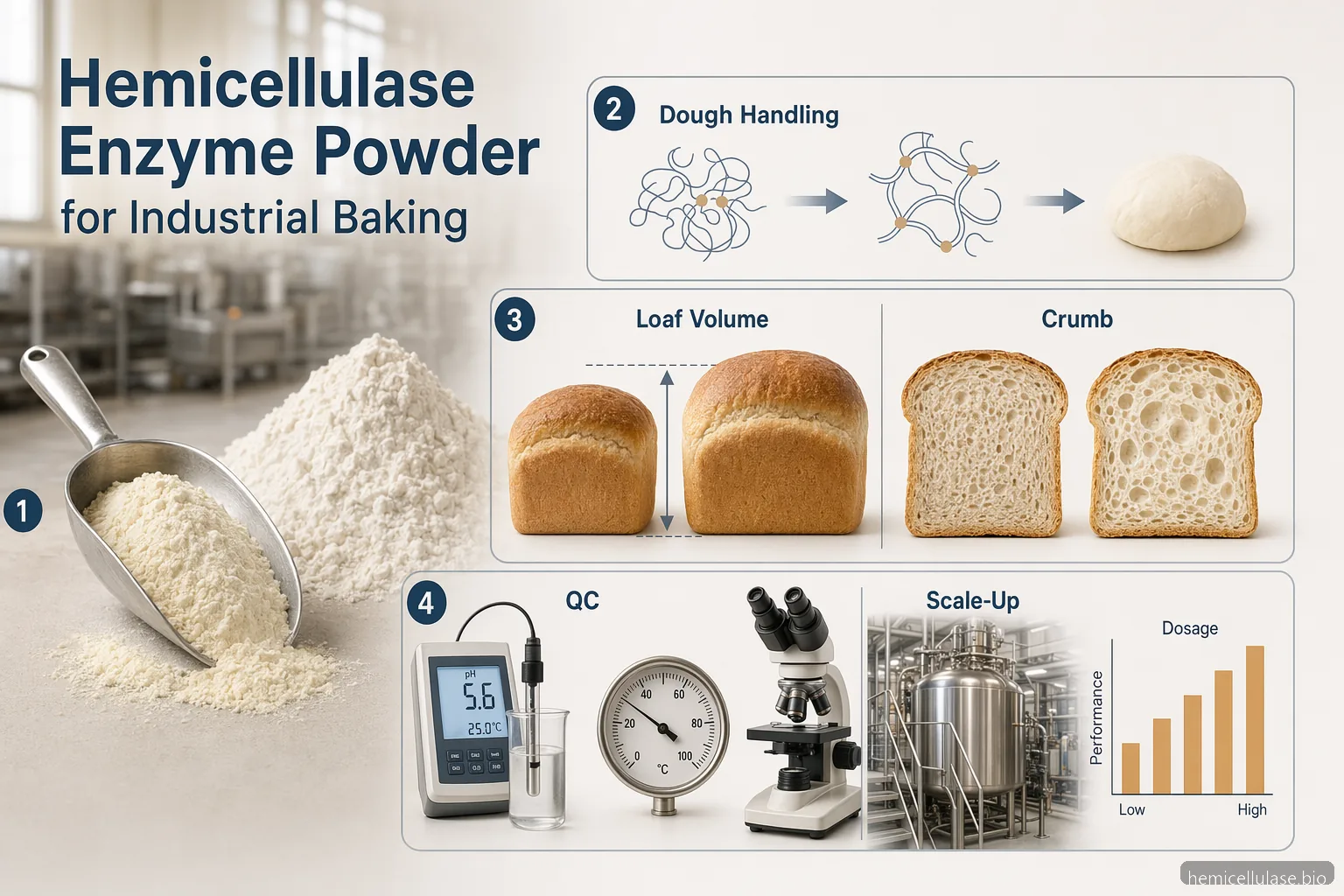
What Hemicellulase Does in Baking
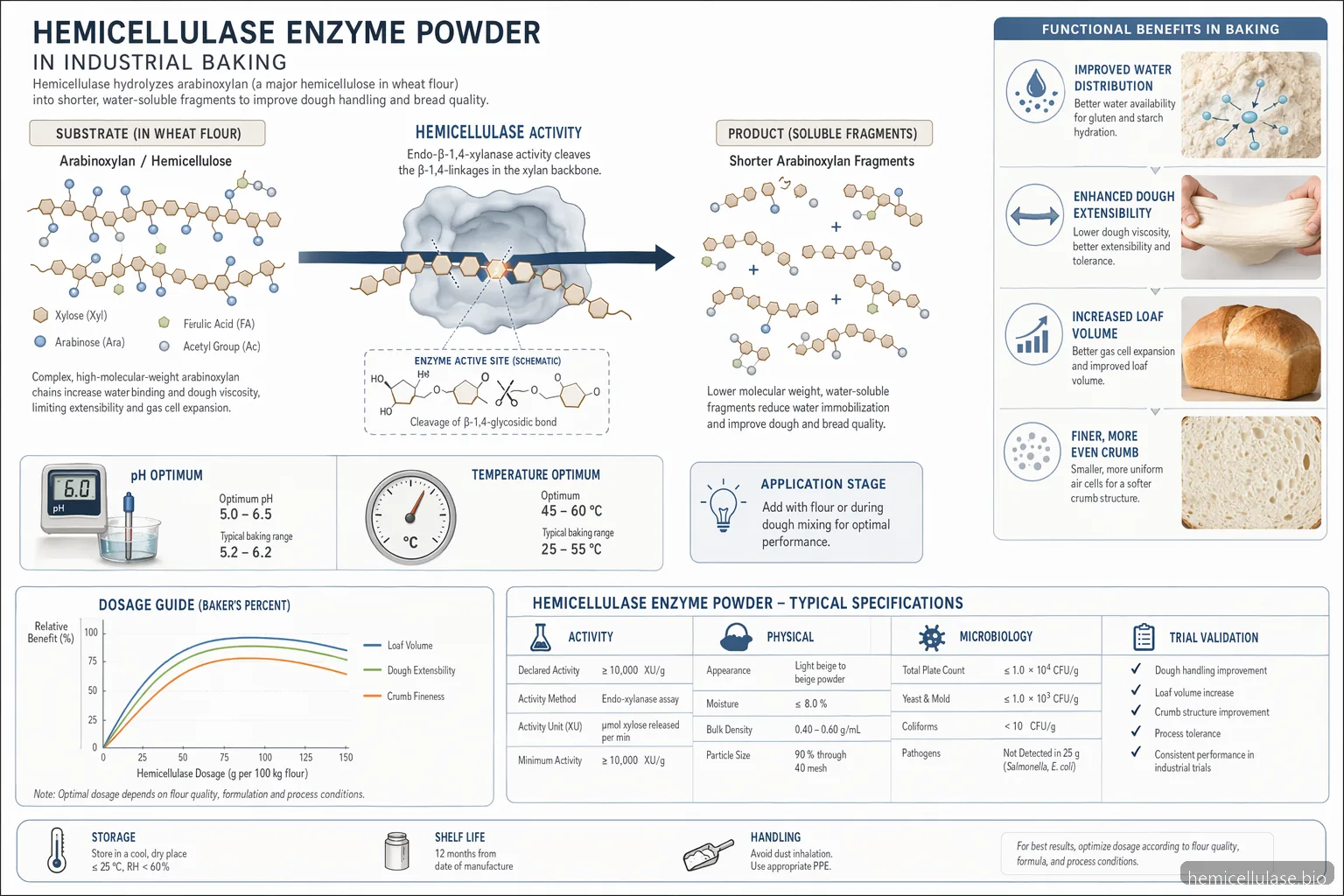
Hemicellulase enzyme powder is used in industrial baking to modify non-starch polysaccharides in flour, especially arabinoxylans found in wheat bran and endosperm cell walls. The main hemicellulase enzyme function is to partially break down these hemicellulose structures, which can improve water distribution, dough extensibility, gas retention, and crumb softness when properly dosed. In commercial formulas, hemicellulase may be used alone or as part of a xylanase mannanase complex, depending on flour type and product target. For bread, buns, rolls, tortillas, and laminated doughs, the objective is not aggressive hydrolysis; it is controlled modification during mixing, fermentation, proofing, and early baking. Overdosing can create sticky dough, weak structure, or excessive softness, so activity level and application testing matter more than simple inclusion rate. Buyers comparing enzyme hemicellulase options should review declared activity, carrier system, solubility, granulation, and consistency between production lots.
Primary targets: arabinoxylans, mannans, and related hemicellulose fractions. • Common outcomes: improved machinability, volume, crumb uniformity, and softness. • Application fit depends on flour ash, protein, absorption, and fermentation time.
Recommended Process Conditions and Dosage
For industrial hemicellulase enzyme baking trials, starting dosage is commonly screened in the range of 10-100 ppm based on flour weight, or according to the supplier activity unit recommendation. Lower levels may suit strong flour or short-time processes, while higher levels may be tested in whole wheat, high-fiber, frozen dough, or flour with high water absorption. Hemicellulase generally performs in mildly acidic to near-neutral dough systems, with practical activity often evaluated around pH 4.5-6.5. Temperature exposure during mixing and fermentation is typically 20-38°C, while enzyme action slows or denatures as dough temperature rises during baking. Exact performance depends on enzyme origin, formulation, and heat stability. A safe development plan uses bench screening, pilot production, and line confirmation before full adoption. Keep water, mixing energy, yeast level, oxidants, emulsifiers, and proof time constant during trials so the hemicellulase effect can be measured clearly.
Trial range: 10-100 ppm on flour weight unless activity data indicates otherwise. • Typical dough pH evaluation range: 4.5-6.5. • Typical fermentation and proof exposure: 20-38°C.
Quality Control Checks for Commercial Trials
A bakery trial for hemicellulase enzyme powder should be designed around measurable quality control endpoints, not only operator impressions. Begin with flour characterization, including moisture, protein, ash, falling number, damaged starch, and water absorption where relevant. During mixing, record mixing time, torque or amperage trend, dough temperature, absorption, and stickiness. During fermentation and proofing, monitor volume development, gas retention, proof tolerance, and dough strength. Finished product checks should include loaf or bun volume, height-to-width ratio, crumb grain, sliceability, moisture, texture profile over shelf life, and sensory acceptance. If the product is frozen dough or par-baked, include freeze-thaw stability and bake-off performance. Compare each hemicellulase enzyme against a no-enzyme control and any existing improver system. The best option is usually the one that meets product specifications at the lowest cost-in-use without increasing line downtime, scrap, or formulation complexity.
Use side-by-side controls with identical flour and process settings. • Track both fresh product quality and shelf-life performance. • Confirm that enzyme addition does not increase dough stickiness or divider issues.
Supplier Documentation and Qualification
Industrial buyers should qualify hemicellulase suppliers with documentation that supports food manufacturing, plant handling, and repeatable performance. Request a current Certificate of Analysis for each lot, a Technical Data Sheet describing activity, dosage guidance, application range, storage conditions, and shelf life, and a Safety Data Sheet for worker handling and dust-control review. Depending on internal requirements, buyers may also request allergen statements, country of origin, carrier declaration, GMO status statement, microbiological limits, heavy metal limits, and packaging specifications. Avoid relying only on marketing claims such as broad statements about performance or unspecified enzyme units. Ask how activity is measured, what substrate is used, and whether the method is comparable across lots. Supplier qualification should include sample evaluation, pilot validation, procurement review, change-control expectations, lead time, minimum order quantity, and technical support availability for troubleshooting on the production line.
Core documents: COA, TDS, SDS, and lot traceability. • Confirm activity method, carrier, storage, shelf life, and packaging. • Define notification requirements for formulation or manufacturing changes.
Cost-in-Use and Scale-Up Strategy
The lowest-priced hemicellulase enzyme powder is not always the lowest-cost solution. Cost-in-use should be calculated from dosage, activity, yield impact, scrap reduction, line efficiency, flour flexibility, and finished product performance. A concentrated product may cost more per kilogram but require a lower inclusion rate, while a diluted powder may simplify dosing but increase storage and handling volume. During scale-up, confirm that the enzyme disperses uniformly in flour or premix and that micro-ingredient feeders can dose it accurately. Validate performance across seasonal flour variation, different production shifts, and normal processing windows. If hemicellulase is part of a broader improver system, test interactions with amylase, lipase, oxidants, reducing agents, emulsifiers, hydrocolloids, and preservatives. The commercial target is a stable specification: improved dough handling and product quality without creating sensitivity to minor process variation or requiring frequent formulation adjustments.
Compare products by cost per metric ton of flour treated. • Include yield, scrap, shelf life, and downtime in the calculation. • Run pilot trials before committing to plant-wide implementation.
Related Industrial Uses Beyond Baking
Although this page focuses on industrial hemicellulase enzyme baking, the same enzyme category is used in other biomass-processing sectors. Industrial hemicellulase enzyme pulp and paper applications may support fiber modification, drainage improvement, or bleaching aid strategies when matched to mill conditions. Industrial hemicellulase enzyme biofuel processes use xylanase, mannanase, and related activities to help release fermentable sugars from lignocellulosic feedstocks as part of a broader enzyme cocktail. In animal feed, hemicellulase may be used to reduce viscosity and improve access to nutrients in grain-based diets. These applications require different pH, temperature, activity profiles, regulatory review, and QC testing than baking. Therefore, buyers should specify the intended use when asking what is hemicellulase enzyme best suited for. A baking-grade product should be evaluated for food-process compatibility, flour performance, and bakery handling rather than selected solely because it works in another industry.
Application sectors include baking, animal feed, biofuel, and pulp and paper. • Each sector requires different activity profile and validation criteria. • Do not transfer dosage assumptions between industries without testing.
Technical Buying Checklist
Buyer Questions
Hemicellulase enzyme powder is used to partially modify hemicellulose fractions in flour, especially arabinoxylans. In baking, this can help improve dough extensibility, water distribution, gas retention, crumb structure, and softness when the dosage is optimized. It is typically evaluated in bread, buns, rolls, tortillas, high-fiber products, and frozen dough systems using controlled trials.
Start with a controlled bench trial using the supplier's activity-based recommendation, often screened around 10-100 ppm on flour weight. Compare multiple levels against a no-enzyme control while holding flour, water, mixing, yeast, fermentation, and proofing conditions constant. The correct dosage is the level that meets product specifications without causing sticky dough, weak structure, or processing instability.
Buyers should request a lot-specific COA, current TDS, SDS, activity method, storage guidance, shelf-life data, and packaging details. Depending on internal approval requirements, also ask for allergen information, carrier declaration, country of origin, microbiological limits, heavy metal limits, and change-control expectations. These documents support supplier qualification and help purchasing, quality, and production teams evaluate risk.
Yes, hemicellulase is often evaluated with amylase, lipase, glucose oxidase, protease, or other functional ingredients in improver systems. Interactions can be positive or negative depending on flour quality, formula, and process time. Pilot validation is important because a combination that improves loaf volume may also change dough strength, stickiness, softness, or shelf-life texture.
Cost-in-use should be calculated per metric ton of flour treated, not only by enzyme price per kilogram. Include dosage, activity concentration, handling losses, yield improvement, scrap reduction, line efficiency, shelf-life impact, and any formulation changes. A higher-priced enzyme may be more economical if it works at a lower dose and improves consistency at scale.
Hemicellulase (Xylanase + Mannanase Complex) for Research & Industry
Need Hemicellulase (Xylanase + Mannanase Complex) for your lab or production process?
ISO 9001 certified · Food-grade & research-grade · Ships to 80+ countries
Frequently Asked Questions
What is hemicellulase enzyme powder used for in baking?
Hemicellulase enzyme powder is used to partially modify hemicellulose fractions in flour, especially arabinoxylans. In baking, this can help improve dough extensibility, water distribution, gas retention, crumb structure, and softness when the dosage is optimized. It is typically evaluated in bread, buns, rolls, tortillas, high-fiber products, and frozen dough systems using controlled trials.
How should a bakery determine the right hemicellulase dosage?
Start with a controlled bench trial using the supplier's activity-based recommendation, often screened around 10-100 ppm on flour weight. Compare multiple levels against a no-enzyme control while holding flour, water, mixing, yeast, fermentation, and proofing conditions constant. The correct dosage is the level that meets product specifications without causing sticky dough, weak structure, or processing instability.
What documents should B2B buyers request from a supplier?
Buyers should request a lot-specific COA, current TDS, SDS, activity method, storage guidance, shelf-life data, and packaging details. Depending on internal approval requirements, also ask for allergen information, carrier declaration, country of origin, microbiological limits, heavy metal limits, and change-control expectations. These documents support supplier qualification and help purchasing, quality, and production teams evaluate risk.
Can hemicellulase be blended with other bakery enzymes?
Yes, hemicellulase is often evaluated with amylase, lipase, glucose oxidase, protease, or other functional ingredients in improver systems. Interactions can be positive or negative depending on flour quality, formula, and process time. Pilot validation is important because a combination that improves loaf volume may also change dough strength, stickiness, softness, or shelf-life texture.
How is cost-in-use calculated for hemicellulase enzyme?
Cost-in-use should be calculated per metric ton of flour treated, not only by enzyme price per kilogram. Include dosage, activity concentration, handling losses, yield improvement, scrap reduction, line efficiency, shelf-life impact, and any formulation changes. A higher-priced enzyme may be more economical if it works at a lower dose and improves consistency at scale.
Request a Quote for Wholesale or Bulk Supply
Improver makers, bakeries and resellers: send the product, the quantity per order and per year, the destination country and your flour or premix type. We reply with a recommended grade, a sample offer with COA and TDS, and a quote per order. See our application page for Hemicellulase Enzyme for Animal Feed Digestibility at /applications/hemicellulase-animal-feed-digestibility/ for specs, MOQ, and a free 50 g sample.
Contact Us to Contributehello@mail.hemicellulase.bio